
The PGCert / PGDip / MSc
in Digital Health
Develop practical expertise in digital healthcare

Fully Online

Course Length
Why Digital Health, Why Now
Digital solutions are moving from small-scale pilots into everyday practice across the NHS and social care. Decisions about which technologies to adopt, how to govern them, and how to support patients and colleagues through the change are increasingly made by people who understand both the clinical and the digital sides of care.
This programme gives you that grounding. You will learn to evaluate new technologies critically, understand the regulatory and governance issues that surround them, and apply them within your own service. As digital healthcare evolves, you will stay abreast.
Who This Course Is For
This programme is designed for healthcare and social care professionals who want to build practical capability in digital health, and apply it directly in their own practice.
Ideal for: clinicians, service managers, digital transformation leads, health informaticists, allied health professionals, and anyone with responsibility for introducing, evaluating or governing digital health solutions within their organisation.
Course Aims
- To provide an overview and deeper understanding of digital health including the types of solutions, applications of those solutions, challenge to successful application and the impact of progressing digital health on patients across the UK
- To equip students to understand the application of artificial intelligence, wider informatics applications, and their application in healthcare
- To equip students with the knowledge and skills to encourage continuous consideration of digital health solutions to support their practice
- To understand how digital technology is being, and could be, developed further to help support remote and rural medicine
- To provide students with skills to critically appraise evidence of the effectiveness of new technologies in health
- To understand the role of digital health in reducing health inequalities and improve access to, and promotion of, ‘health’ in challenged or hard to reach populations
- To understand the regulations, regulatory framework, governance of public acceptability of new technologies in healthcare
- To equip students in their future practice of how best to encourage adoption of digital health across health and social care sectors
- To provide students with the opportunity to undertake an element of independent study (MSc only)
Course Structure
- The Digital Health programme is designed around three connected qualifications, each a complete exit point in its own right, and each building on the last.
- The PGCert’s three compulsory modules carry forward into the PGDip, which adds a compulsory module and two chosen electives. The PGDip in turn carries forward into the MSc, which adds a final dissertation or professional project.
- Credits accumulate accordingly: 60 for the PGCert, 120 for the PGDip, 180 for the MSc.
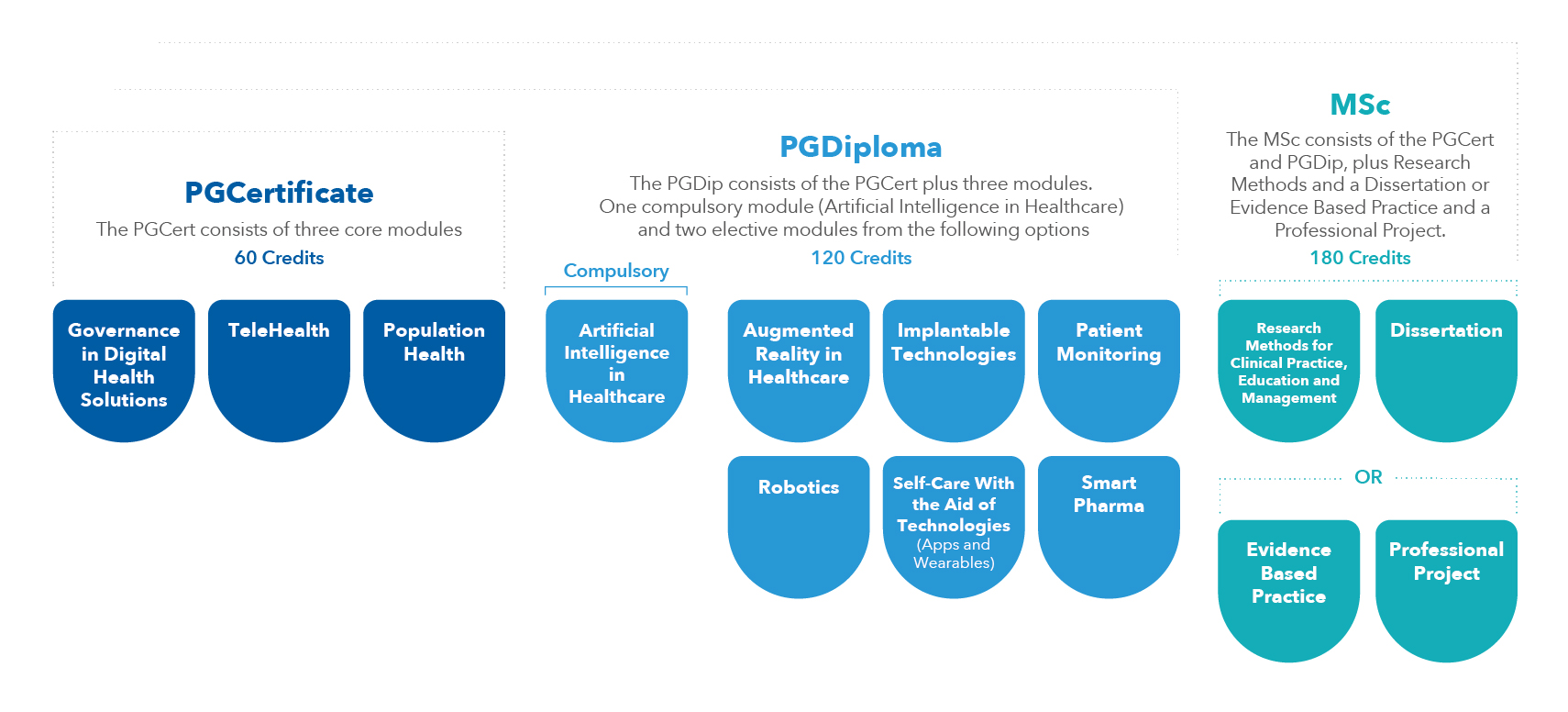
Compulsory Modules (20 Credits)
TeleHealth (PGCert)
Population Health (PGCert)
Artificial Intelligence in Healthcare (PGDip)
Elective Modules (20 Credits; PGDip)
Self-care with the Aid of Technologies (Apps and Wearables)
Smart Pharma
Implantable Technologies
Patient Monitoring
Augmented Reality in Healthcare
MSc – Choose one route
Research Methods for Clinical Practice, Education and Management (20 credits) AND Dissertation (40 credits)
OR
Evidence Based Practice (20 credits) AND Professional Project (40 credits)
Learning Strategy
- This programme is taught fully online. At no point in time do students need to come to us to complete their studies. Study materials and interactions are delivered through our learning system and other communication tools.
- Course materials are designed to provide a variety of media, and to maximise engagement. They include: mini-lectures, animations, interactive e-learning units, audio recordings, exercises, reflections, discussions and workshops.
Assessment
- Assessment for each module will encompass a range of methods depending on the selected educational pathway, for example: reflective coursework, presentations, viva, written summaries, case studies and assessment of acquired skills and knowledge.
- All assessments are conducted and submitted online and, wherever possible, are subject to thorough plagiarism checks.
Expert Perspective
“I have a passion for digital health and the things that really could be done in the future for patients and for clinicians in improving access and improving safety in a digital way for healthcare.”
Chris Whittle
Founder and CEO at Q doctor, subject matter expert contributor to this programme
Ready to get ahead in digital health?