
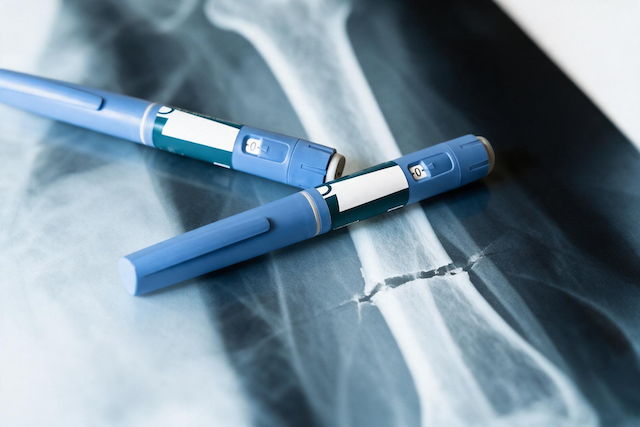
GLP-1 Therapies Linked to Lower Fragility Fracture Risk in Adults Living With Type 2 Diabetes
Key Takeaways:
- Adults aged 50 and over living with type 2 diabetes who started a GLP-1 receptor agonist had a 21% lower three-year risk of fragility fracture than those starting a DPP-4 inhibitor (HR 0.79).
- Reductions were strongest for vertebral (HR 0.68) and hip or femur fractures (HR 0.70), and appeared independent of changes in BMI and HbA1c – pointing to a possible direct skeletal effect.
- The findings do not extend to younger people using GLP-1 medications for weight management alone, or to those with osteoporosis; among adults without diabetes, fracture risk was higher (HR 1.13).
A large-scale look at bone health during GLP-1 treatment
Initiating a GLP-1 receptor agonist for type 2 diabetes was associated with a lower risk of fragility fractures in adults aged 50 and over, including fractures of the hip and spine, according to a large target trial emulation study published in JAMA Network Open.
Over three years of follow-up, adults who newly started a GLP-1 medication had a 21% lower risk of fragility fracture than those who newly started a DPP-4 inhibitor (HR 0.79, 95% CI 0.76–0.83), reported Christopher Hamad, MD, of the University of California Los Angeles, and colleagues.
The authors were careful to frame the size of the effect in context rather than overstate it.
“Although the absolute risk reduction at 3 years was modest (0.79%), this magnitude is clinically relevant given a baseline 3-year major osteoporotic fracture risk of approximately 3% to 4% in comparable populations and the substantial morbidity and mortality associated with hip and vertebral fractures,” the authors wrote.
Why a modest absolute reduction still matters
The clinical weight of these numbers rests on how serious the events being prevented are. Hip fractures, for example, are associated with one-year mortality rates of up to 25% in women and up to 36% in men.
Given the potential for such severe outcomes, Hamad’s group emphasised that even modest absolute reductions in fragility fractures – which stem from low-energy trauma, such as a fall from standing height – can prevent a meaningful number of events at population level.
The findings build on several smaller observational studies in people living with diabetes that have similarly linked the use of GLP-1 medications such as semaglutide (Ozempic, Wegovy) to a reduced fracture risk. Hamad’s team noted that their analysis drew on the largest dataset assembled on this question to date.
Which fractures showed the strongest signal
The protective association was most pronounced at precisely the sites that carry the highest morbidity and mortality:
- Vertebral fractures: HR 0.68, 95% CI 0.63–0.73
- Hip or femur fractures: HR 0.70, 95% CI 0.63–0.79
- Rib fractures: HR 0.83, 95% CI 0.77–0.91
No significant associations were identified for fractures of the distal radius or ulna, or of the proximal humerus.
Weight loss, glycaemic control and the question of a direct skeletal effect
One of the more striking elements of the analysis concerns the mechanism. Mediation analyses indicated that the associations were independent of changes in BMI and HbA1c, a pattern consistent with a potential direct skeletal effect of GLP-1 medications.
That matters because weight loss itself is associated with reduced bone mineral density and a higher fracture risk – a relationship reflected in the study’s own data, which found that cumulative BMI loss was tied to a 2% increase in fracture risk. In other words, the expected consequence of the weight reduction these medications produce would be a rise in fracture risk, not a fall.
“Yet, GLP-1 RA [receptor agonist] use was associated with lower fracture risk despite these changes, suggesting that potential direct skeletal effects may outweigh the adverse consequences of weight loss,” the authors wrote.
Reassessing the assumption of neutral skeletal effects
Current American Diabetes Association Standards of Care classify GLP-1 medications as having neutral effects on the skeleton. The researchers argued that their results suggest this assumption warrants reevaluation.
They also acknowledged the limits of what an observational design can establish, noting that the findings could still reflect unmeasured factors such as improved balance or greater physical activity among people taking these medications. Making sense of evidence like this – and of the mechanistic arguments used to interpret it – is the focus of professional training such as the College of Contemporary Health’s GLP-1RAs in Focus, a CPD-accredited online short course that grounds healthcare professionals in how these medications act on the body.
How the study was conducted
For this comparative effectiveness study, the researchers drew data from the TriNetX Research Network, analysing 66,803 matched pairs, or 133,606 people in total, aged between 50 and 90 years.
Mean age was approximately 63 years, roughly 53% of participants were male, 58% were White, and average baseline BMI was around 33.
All participants were living with type 2 diabetes and had newly initiated either a GLP-1 receptor agonist or a DPP-4 inhibitor between 2015 and 2022. Dulaglutide (Trulicity), semaglutide and liraglutide (Victoza) together accounted for 91% of index prescriptions in the GLP-1 group. Exclusion criteria included fractures resulting from high-energy trauma, as well as osteoporosis and osteopenia.
Where the protective association held – and where it did not
In subgroup analyses, the lower fracture risk was consistent across age groups, across sexes and across levels of frailty.
A separate matched cohort, however, evaluated participants according to diabetes status and produced a notably different picture. Among adults living with type 2 diabetes, GLP-1 use retained a protective association (three-year HR 0.91, 95% CI 0.88–0.95). Among adults without diabetes, it was associated with an increased fracture risk (HR 1.13, 95% CI 1.04–1.23, P<0.001 for interaction).
Consequently, the authors emphasised that the findings cannot be generalised to younger people using GLP-1 medications solely for weight management, nor to those with known osteoporosis or a previous fragility fracture, who were excluded from the study altogether.
What this means for practice
Overall, “the findings do not argue against GLP-1 RA use on the basis of fracture risk, though bone health monitoring remains prudent,” according to the researchers.
They called for prospective randomised trials to evaluate the associations observed, including among people with osteopenia or early osteoporosis, alongside preclinical work to understand the potential mechanisms involved.
CCH insight
For healthcare professionals, this study is a useful reminder that the skeletal consequences of GLP-1 treatment are not yet settled science – and that the answer appears to differ depending on who is being treated and why. Interpreting findings of this kind with confidence depends on a firm grasp of how these medications act in the first place, from gut hormones and appetite regulation through to their wider effects beyond glycaemic control. That is exactly what CCH’s GLP-1RAs in Focus – Why Drugs Like Ozempic Work CPD short course (2 CPD hours, fully online, CPD-accredited) is built to provide, giving clinicians a clear grounding in the mechanisms behind these therapies and the ability to appraise emerging evidence critically, whether or not they prescribe.
Read More
Weight Loss Drugs May Be Linked to Bone Health Risks, Five-Year Study Shows
Key Takeaways:
- A large observational study suggests a modest increase in osteoporosis and related conditions among people taking GLP-1 receptor agonists over five years
- The underlying cause remains unclear, with weight loss itself, rather than the drugs alone, likely contributing to changes in bone health
- Despite these findings, the cardiovascular and metabolic benefits of GLP-1 therapies continue to outweigh potential skeletal risks for most people
Growing use of GLP-1 therapies raises new questions
Glucagon-like peptide-1 receptor agonists, commonly referred to as GLP-1 drugs, are widely used to manage type 2 diabetes and support weight loss. These medications are recognised for their ability to reduce body weight, improve glycaemic control, and lower cardiovascular risk.
However, emerging long-term data are beginning to highlight potential concerns relating to bone health. A new study, presented at the 2026 annual meeting of the American Academy of Orthopaedic Surgeons, examined five years of real-world data and suggests that these treatments may be associated with an increased risk of certain skeletal conditions.
The findings are observational and have not yet undergone peer review. They demonstrate association rather than causation. Nevertheless, given the rapid uptake of GLP-1 receptor agonists, researchers emphasise the need for careful, ongoing evaluation.
Study findings – signals of increased skeletal risk
Researchers analysed medical records from more than 146,000 adults living with obesity and type 2 diabetes over a five-year period.
Among those taking GLP-1 therapies, approximately 4 percent developed osteoporosis, compared with just over 3 percent of those not taking these medications.
Additional findings included:
- Osteomalacia, or bone softening, occurred in around 0.2 percent of people using GLP-1 drugs, compared with 0.1 percent in the control group
- Gout was slightly more common, affecting 7.4 percent of people taking GLP-1 therapies compared with 6.6 percent in those not taking them
Lead researcher Muaaz Wajahath, a medical student at Michigan State University College of Human Medicine, highlighted the importance of emerging long-term data:
“We are just now reaching the precipice where five- and 10-year follow-up data are becoming available for patients taking GLP-1 medications,” Wajahath said. “Any medication that sees this rapid adoption warrants close examination, particularly in orthopedics, where obesity and surgical intervention often overlap.”
Dr Giles Scuderi, an orthopaedic surgeon and vice president of Northwell Orthopedics, commented on the findings:
“The study findings contradict recent assertions of musculoskeletal protection and suggest that GLP-1 RA exposure may confer increased long-term skeletal risk.”
Is the risk driven by the drug or by weight loss?
A key question remains whether the observed risks are directly caused by GLP-1 medications or are instead related to weight loss itself.
People living with obesity and type 2 diabetes already have elevated risks of inflammation and bone fragility. In addition, weight loss – particularly when rapid or substantial – can affect bone metabolism.
Dr James J. Chao explained:
“As with any weight loss, bone remodeling can occur if patients lose weight on these medications.”
Bone remodelling is the continuous process of breaking down old bone and replacing it with new tissue. During periods of calorie deficit, this balance can shift, resulting in net bone loss.
“If patients lose lean mass on these medications, bone health can be affected due to less strain being placed on bones,” he added.
Dr Fernando Ovalle Jr. reinforced that this is not unique to GLP-1 therapies:
“We’ve seen it with bariatric surgery for many years and even with aggressive caloric restriction. That’s not unique to GLP-1s.”
Balancing risks and benefits
Despite these findings, experts continue to support the use of GLP-1 receptor agonists in appropriate patients.
These medications have demonstrated strong benefits, including:
- Improved glycaemic control
- Reductions in blood pressure and lipid levels
- Lower risk of heart attack and stroke
“In high-risk patients, those benefits are substantial and often life-saving,” Ovalle said.
As a result, the overall benefit–risk balance remains favourable in most cases. While there may be a modest increase in fracture or gout risk, these risks can typically be monitored and managed.
Scuderi echoed this perspective:
“Since heart disease is a leading cause of death, the potential risk of muscle and bone problems might be less important.”
He also emphasised the importance of active clinical management rather than passive prescribing.
Practical steps to protect bone health
Healthcare professionals can take a proactive role in supporting people receiving GLP-1 therapies.
Recommended strategies include:
- Ensuring adequate protein intake to support muscle mass
- Maintaining sufficient calcium and vitamin D levels
- Engaging in regular resistance and weight-bearing exercise
- Avoiding excessively rapid or unsupported weight loss
“Strength training, in particular, is critical,” Ovalle said. “Preserving muscle mass protects bone. If a patient loses weight but also loses significant muscle, fracture risk can increase regardless of the medication used.”
Certain groups may require closer monitoring:
- Postmenopausal women
- Older adults
- Individuals with a history of fractures
Gout risk may also increase temporarily during periods of rapid weight loss.
“Regarding gout, rapid weight loss and changes in uric acid metabolism can transiently increase flares,” Ovalle said. “That’s something we’ve seen even outside of GLP-1 therapy.”
Building the nutritional knowledge to guide patients through these supportive measures – adequate protein, key micronutrients and protecting lean mass during weight loss – is the focus of professional training such as the College of Contemporary Health’s Nutrition & Weight Management Essentials, a CPD-accredited online short course.
For individuals concerned about bone health, targeted supplementation may be considered. Scuderi noted that healthcare professionals may recommend therapeutic doses of dietary supplements to support lean mass retention and reduce inflammation.
A signal worth monitoring, not a cause for alarm
While early long-term data suggest a potential association between GLP-1 therapies and bone-related risks, these findings should be interpreted with caution.
The study does not establish causation, and multiple factors – including weight loss, underlying conditions, and changes in body composition – are likely to contribute.
At present, GLP-1 receptor agonists remain a valuable and often transformative option for people living with obesity and type 2 diabetes, provided their use is accompanied by appropriate clinical oversight and supportive lifestyle measures.
CCH insight
With so many people taking GLP-1 medications, it is important to keep researching the long-term effects, and this study sheds important light on potential risks with regard to bone health. The most important message here, however, is that this reminds us how it is vital that patients on GLP-1 therapy need to be carefully monitored and supported, particularly during the first year or so when weight loss is relatively rapid. If bone health is affected, this can be managed and treated. If bone health is affected, this can be managed and treated. Much of that support is nutritional: CCH’s Nutrition & Weight Management Essentials CPD short course (10 CPD hours, fully online, CPD-accredited) gives healthcare professionals a solid grounding in nutrition and weight management, including how to help patients meet their protein, calcium and vitamin D needs and preserve lean muscle during periods of rapid weight loss.
Explore Nutrition & Weight Management Essentials →
Source: The Epoch Times
Read More
AI-Supported Telehealth Enhances Hip Surgery Recovery in Regional Australia
Key Takeaways:
- A co-designed, digitally supported recovery pathway is helping people in regional Australia access surgeon-approved post-operative hip care without the need for long-distance travel.
- The Panacea Pathway integrates predictive analytics and AI-generated insights to monitor progress, identify risks early, and support safer and more consistent recovery at home.
- More than 3,000 at-home clinical appointments have been delivered, with patients reporting greater confidence, improved continuity of care, and fewer missed appointments.
Addressing gaps in regional post-operative care
Hip replacement surgery is among Australia’s most frequently performed orthopaedic operations, and the demand for this intervention continues to grow as the population becomes older. However, people living in regional areas remain disproportionately affected by barriers to appropriate post-operative follow-up. Many must travel long distances to attend surgeon or specialist reviews, face reduced access to multidisciplinary care, and often lack the reassurance that accompanies regular in-person monitoring.
Recognising these persistent challenges, the Fortius Institute for Musculoskeletal Research (FIMR), working in partnership with the Sunshine Coast Orthopaedic Group, identified an opportunity to reshape the recovery experience. Together, they developed the Panacea Pathway: a digitally supported, surgeon-approved rapid recovery pathway delivered directly into people’s homes by nurse practitioners through a Nurse Concierge model.
Co-designing a digital recovery service
To turn this concept into a structured clinical pathway, FIMR partnered with the University of the Sunshine Coast to design the Nurse Concierge service specifically for people recovering from hip arthroplasty. This collaboration was supported by the Queensland Government’s Regional University Industry Collaboration (RUIC) programme, delivered by CSIRO, which connects regional universities with small and medium-sized enterprises to facilitate research partnerships across Queensland.
For the Sunshine Coast Orthopaedic Group, the RUIC partnership offered access to advanced research expertise and data capabilities that would not have been available independently. With direct support from the University of the Sunshine Coast, the team was able to gather a broader and more detailed dataset, providing a stronger foundation for training AI tools using real-world clinical information.
This work resulted in a clinical care pathway combining surgeon-approved best practice with at-home delivery by nurse practitioners. The approach integrates predictive analytics and AI-driven insights to remotely monitor each person’s progress, detect early signs of risk, and support timely intervention. In doing so, it reduces the physical and practical burden on patients while promoting safer and more consistent recovery outcomes.
“Seeing our research directly improve patients’ lives has been incredibly rewarding, and this project is demonstrating our approach is leading to safer, better and faster recovery for patients undergoing major orthopaedic surgery,” said Professor Nick Ralph from the University of Sunshine Coast.
He added: “Working alongside clinicians through the RUIC partnership meant we could refine our data collection methods in real-time, building the robust dataset needed to develop an evidence-based care pathway.”
Impact and future direction
Early feedback on the at-home Nurse Concierge service has been highly positive. More than 3,000 at-home clinical appointments have already been completed, substantially reducing travel time for regional participants and resulting in fewer missed follow-up appointments. Many patients reported feeling more confident in their recovery journey, emphasising the value of personalised monitoring and consistent contact with the same nurse practitioner.
“This project has demonstrated how remote care and digital health tools can reimagine the patient journey,” said Dr Stephanie Chaousis, Head of Digital Innovation at FIMR.
“By combining clinical expertise with data-driven insights, we’re not just improving recovery outcomes – we’re establishing a new standard for musculoskeletal care.”
The extensive dataset collected through the programme is now informing further enhancements to the pathway for joint replacement patients. Building on the success of the hip surgery pilot, the Sunshine Coast Orthopaedic Group intends to expand the Panacea Pathway to include knee replacement procedures.
With its strong foundation in real-world data, interdisciplinary collaboration, and AI-enabled monitoring, the Panacea Pathway offers a scalable model that could be adopted across hospital networks. Its principles have the potential to inform future clinical guidelines and broaden access to safer, more equitable recovery pathways for people throughout Australia.
Read More