
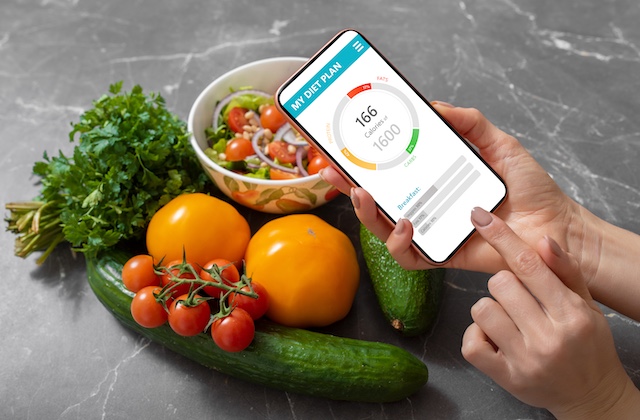
AI Calorie Tracking Apps: Convenient, Popular and Consistently Inaccurate
Key Takeaways:
- Four popular photo-based calorie apps underestimated meal energy by 250 to 345 calories and fat by around 30 grams – roughly a third in both cases.
- Accuracy varied: higher-calorie meals fared better than lower-calorie ones, and carbohydrates were estimated more consistently than other macronutrients.
- Ketogenic meals proved hardest to assess, because their high fat content is consistently underestimated.
Convenience that comes with a margin of error
Advances in artificial intelligence have changed how many people record what they eat. Rather than weighing ingredients or searching a database entry by entry, a person can now photograph a plate of food and let an app estimate its nutritional content in seconds. The convenience is obvious. The accuracy, according to new research, is rather less reliable.
A study conducted at the National Institutes of Health (NIH) Clinical Center compared four popular photo-based apps against meals prepared under tightly controlled laboratory conditions. All four underestimated both calories and fat by approximately a third.
How photo-based calorie tracking works
Photo-based calorie tracking uses AI image recognition to identify the foods present in a photograph of a meal and to estimate the portion sizes on the plate. Those identifications and estimates are then matched against nutrition databases, which the app uses to calculate the energy and macronutrient content of the meal.
The appeal for people managing their weight or monitoring their intake for other health reasons is that the process removes several steps of manual data entry. The trade-off is that the app is making two judgements at once – what the food is, and how much of it there is – before any nutritional calculation begins.
“Photo-based calorie tracking apps are very popular, especially for people trying to manage their health or lose weight,” said Aaron Hengist, a postdoctoral visiting fellow with the Intramural Program of the National Institute of Diabetes and Digestive and Kidney Diseases (NIDDK), part of the National Institutes of Health. “However, the accuracy of many of these apps has not been thoroughly evaluated. Our study helps address this question by looking at whether these apps can reliably estimate calories.”
A metabolic kitchen as the reference standard
The research forms part of a larger diet study at the NIH Clinical Center examining how the body processes nutrients when a person follows either a low-carbohydrate (ketogenic) diet or a standard diet.
Meals for that clinical trial are prepared in a controlled metabolic kitchen – a research kitchen in which every ingredient is weighed to the nearest 0.1 gram. That level of precision gave the investigators something unusual: a set of real, plated meals whose exact nutritional composition was already known.
The researchers took standardised photographs of 102 meals prepared for the diet study and ran the images through four apps: MyFitnessPal, LoseIt!, CalAI and Appediet.
“By using meals prepared in a tightly controlled metabolic kitchen, we were able to compare the apps’ estimates against a precise reference,” said Hengist. “This kind of direct, high-quality comparison hasn’t been available before.”
What the analysis found
Across the 102 meals, all four apps underestimated energy content by approximately 250 to 345 calories on average. Fat was underestimated by around 30 grams. In percentage terms, both calories and fat came in roughly a third below the true values recorded in the metabolic kitchen.
For a person using an app to guide daily intake, an error of this size is not trivial. A consistent shortfall of 250 to 345 calories per meal, repeated across a day, would produce a substantially inaccurate picture of overall energy intake – and would do so in the direction least helpful to someone trying to reduce it.
Where the apps performed better
The findings were not uniformly negative. The analysis showed that MyFitnessPal and LoseIt! estimated the energy content of higher-calorie meals more accurately than lower-calorie meals. All four apps also estimated carbohydrates more consistently than the other macronutrients, suggesting that carbohydrate-containing foods may be easier for image recognition systems to identify and quantify than fats in particular.
Hengist was direct about the practical implication for people using these tools without adjusting the app’s output.
“People using a photo-based tracking app without adjusting the portions or entering the amounts of food should take the results with a grain of salt,” said Hengist. “These apps tend to underestimate calories, especially from fats, so what they actually ate is likely higher than what the app shows.”
Ketogenic meals pose a particular challenge
After completing the initial analysis, the researchers extended the work to more than 200 additional meals in order to understand what factors influence app accuracy.
Their early results suggest that the apps struggle more with meals forming part of a low-carbohydrate ketogenic diet. The likely explanation is straightforward: these meals derive a large proportion of their energy from fat, and fat is precisely the macronutrient the apps most consistently underestimate.
This has implications for anyone supporting people who follow ketogenic or other high-fat dietary patterns, whether for weight management, metabolic health or the management of specific conditions. The tracking tool a person is relying on may be least accurate in exactly the dietary context where fat intake matters most.
For healthcare professionals who regularly review food diaries or app exports during weight management consultations, findings of this kind reinforce the value of structured training in dietary assessment. The College of Contemporary Health’s CPD-accredited Nutrition and Weight Management Essentials short course covers how dietary intake is assessed in practice, the limitations of self-reported data, and how to have constructive conversations with people about what and how much they are eating.
Improving accuracy in the real world
The investigators do not conclude that photo-based tracking should be abandoned. Their view is that combining photo-based features with more traditional methods of measuring diet quality could improve the real-world accuracy of calorie-tracking apps. In practical terms, that means treating the photograph as a starting point rather than a finished record – confirming what the app has identified, adjusting portion sizes, and entering quantities where they are known.
Olivia Charles, a postbaccalaureate intramural research training fellow at NIDDK, will present the findings at NUTRITION 2026, the flagship annual meeting of the American Society for Nutrition, held 25–28 July in National Harbor, Maryland, just outside Washington, D.C. As with research presented at scientific meetings generally, the results should be regarded as preliminary until they appear in a peer-reviewed publication.
For people using these apps day to day, the practical message is a modest one. A photograph is a useful prompt and a low-friction way to build a habit of recording intake. It is not, on the current evidence, a measurement.
CCH insight
Digital tools are increasingly part of how people monitor their diet, but their outputs need to be interpreted rather than accepted at face value – particularly where fat intake or high-fat dietary patterns are involved.
The College of Contemporary Health’s Nutrition and Weight Management Essentials CPD short course equips healthcare professionals with a working understanding of dietary assessment, macronutrient composition and evidence-based weight management, including how to interpret self-reported and app-generated intake data in clinical conversations.
Explore Nutrition and Weight Management Essentials
Source: EurekAlert!
Read More