

Will Wider Use of GLP-1s Mean Fewer Pills for Older Adults? Yale Study Offers a Reality Check
Key Takeaways:
- Yale researchers found that roughly 15% of polypharmacy cases in adults aged 65 and older – about 3.3 million of 22 million – are attributable to obesity.
- GLP-1 medications are unlikely to meaningfully reduce overall prescription burden in this age group, and their side effects may add further medications.
- From July, eligible Medicare beneficiaries will gain broad access to GLP-1s for obesity treatment under a federally funded demonstration programme running until December 2027.
Rethinking the promise of GLP-1s in geriatric care
As people grow older, they tend to accumulate chronic conditions, many of which require ongoing pharmacological management. While prescription medications play an essential role in disease control, polypharmacy – generally defined as the regular use of five or more drugs – carries a heightened risk of adverse effects, drug–drug interactions, and contraindications. With glucagon-like peptide-1 receptor agonists (GLP-1s) now reshaping obesity care, an open question has emerged: could effectively treating obesity in older adults reduce the number of medications they need overall?
A new study from Yale, published in the Journal of General Internal Medicine, sets out to answer that question by quantifying how much polypharmacy in adults aged 65 and older can be attributed to obesity in the first place.
The theory being tested
The investigators were motivated by a hypothesis that has gained traction in recent years: that better treatment of obesity could cascade into reduced reliance on medications for obesity-related complications such as type 2 diabetes, hypertension, and dyslipidaemia.
“Some in the medical community have theorized that if older adults are treated with GLPs, they can be on fewer medications because we’re treating their obesity and thereby treating other obesity-related conditions,” says Alissa Chen, MD, MPH, instructor of medicine (general medicine) and first author of the study.
To test the assumption, the team examined the extent to which polypharmacy in adults aged 65 and older could be statistically attributed to obesity.
What the study found
The researchers determined that approximately 15% of polypharmacy cases in this population were attributable to obesity. In absolute terms, this represented around 3.3 million of an estimated 22 million cases.
“While that is a lot of patients, there’s certainly a large majority of polypharmacy cases which are not attributable to obesity,” Chen adds.
The implication is significant. Even if GLP-1 therapy proves highly effective at treating obesity and its complications in older adults, the broader medication burden in this age group is driven largely by factors unrelated to body weight. As a result, GLP-1s are unlikely to substantially reduce the total number of prescriptions taken by people aged 65 and over, although they may still meaningfully improve obesity-related health outcomes.
A crossroads for obesity medications in older adults
Research into the use of obesity medications in older adults remains limited, and the long-term implications of widespread GLP-1 prescribing in this population are not yet well understood.
“We’re at a crossroads for the use of obesity medications like GLPs in older adults. This study gives us a first glimpse into one way in which GLPs may change the face of health and healthcare for older adults,” says Alexandra M. Hajduk, PhD, MPH, research scientist (geriatrics) and senior author of the study.
Chen also points out that the side-effect profile of GLP-1 therapy is itself worth considering when projecting medication burden. Common adverse effects, including nausea, acid reflux, and diarrhoea, may prompt the addition of over-the-counter or prescription remedies, potentially offsetting any reductions in other classes of medication.
Expanded medicare access from july
The clinical context is changing rapidly. Starting in July, obesity medications will become available at low cost for eligible Medicare beneficiaries under a federally funded demonstration programme running until December 2027. For the first time, GLP-1 medications will be broadly covered by Medicare for the treatment of obesity.
This expansion is widely expected to drive a surge in GLP-1 prescriptions among older adults. What happens after the demonstration period ends, however, is uncertain. If prices rise sharply once the programme concludes, many people may face the prospect of either paying out of pocket or stopping treatment altogether.
The risks of discontinuation
Stopping GLP-1 therapy is not a neutral event, particularly for older adults whose metabolic health may have improved markedly on treatment.
“Discontinuing can lead to worsened insulin resistance, and gaining more fat tissue than had been lost,” Chen says. “This may be dangerous, with some patients ending up in a worse situation after stopping than they were before starting.”
This raises difficult clinical and policy questions about how to ensure continuity of care once the demonstration programme concludes, and how to counsel older adults about the long-term commitment that GLP-1 therapy may represent.
The continuing role of medical reconciliation and deprescribing
The findings reinforce the importance of established tools for managing medication burden in older adults, rather than relying on a single new drug class to resolve polypharmacy.
“The tried-and-true methods for polypharmacy are medical reconciliation and rational deprescribing,” says Chen. “Many of these approaches, developed by and publicized by the National Institutes of Health-funded U.S. Deprescribing Research Network, are effective tools for geriatricians and primary care doctors.”
The researchers conclude that medication burden must remain front of mind when treating older adults, and that further research is needed to clarify how obesity medications affect health outcomes specifically in this age group.
Additional authors on the study include Ashwin Chetty, John Batsis, MD, and Kasia Lipska, MD, MHS.
Source: Yale School of Medicine
Read More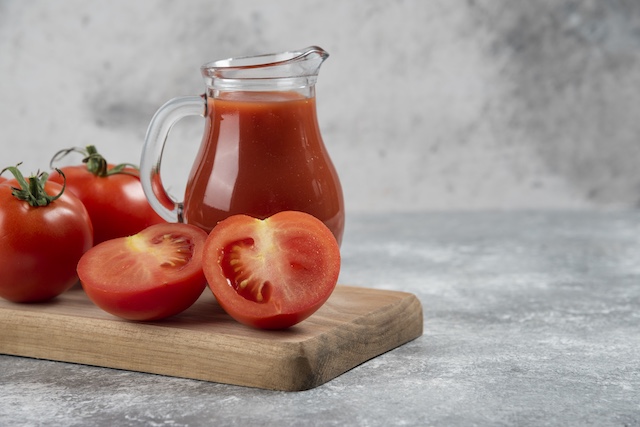
Four Weeks of Tomato-Soy Juice Lowered Inflammation in Adults with Obesity
Key Takeaways:
- In a four-week study, a tomato-soy juice rich in lycopene and soy isoflavones significantly reduced three blood markers of systemic inflammation in healthy adults with obesity, while a control tomato juice lacking those compounds did not.
- The researchers chose a low-carotenoid tomato juice as the comparison drink, rather than water, so they could isolate the effects of the lycopene and isoflavones rather than the effects of tomato juice in general.
- Building on these results and supporting animal data, the team has secured federal funding for a pilot clinical trial examining whether the same juice can ease inflammation in people living with pancreatitis.
A food-based approach to inflammation
Drinking a tomato-soy juice packed with plant compounds previously shown in animal studies to support health lowered pro-inflammatory proteins in healthy adults with obesity after four weeks, according to a new study. The researchers say the findings point to the juice’s potential as a functional food that could help rein in the persistent, unchecked inflammation that underpins a wide range of chronic conditions.
The juice was formulated to deliver high levels of two plant-based compounds, lycopene and soy isoflavones, both of which earlier research suggests have antioxidant and anti-inflammatory properties. Measured against a control tomato juice that lacked these compounds, the tomato-soy juice produced a significant drop in the blood levels of three proteins that serve as markers of systemic inflammation.
“The idea is, can we use food-based interventions to modulate inflammation?” said lead author Jessica Cooperstone, associate professor of horticulture and crop science at The Ohio State University. “And can we test this in a rigorous way so that we can really see this is affecting inflammation, versus just saying something is anti-inflammatory?”
The study was published recently in the journal Molecular Nutrition & Food Research.
What is in the juice
Lycopene is a carotenoid, the class of pigments responsible for the colours of tomatoes and various other vegetables. Soy isoflavones are flavonoids that mimic the action of the hormone oestrogen. Both are phytochemicals, naturally occurring compounds that help plants thrive.
Years ago, drawing on studies that linked diets rich in either tomato products or soy with a reduced risk of prostate cancer, Ohio State researchers developed the tomato-soy juice. It was made using tomatoes bred to contain a high concentration of lycopene – varieties also developed and grown at Ohio State – and then enriched with a soy isoflavone extract.
Subsequent research at the university connected a higher intake of the tomato-soy juice with reduced prostate-specific antigen levels in some men with prostate cancer. Studies conducted elsewhere have likewise suggested that tomatoes and soy, whether eaten separately or together, can influence inflammatory and metabolic pathways tied to obesity and other chronic illnesses.
“There’s been enough compelling evidence that compounds from tomatoes and soy might be modulating inflammation that we decided to test this in people,” Cooperstone said.
How the study was carried out
For the new study, 12 healthy adults with obesity drank two 6-ounce cans of the tomato-soy juice every day for four weeks. Following a washout period, the same participants then consumed the low-carotenoid control tomato juice for a further four weeks.
The choice of comparison drink was deliberate. Rather than pitting the juice against plain water, the team selected a tomato juice stripped of the key compounds so that any difference could be attributed to those compounds specifically.
“The hypothesis is that it’s the lycopene from the tomatoes and the isoflavones from the soy that’s inducing the effect, so we didn’t want to have a control that’s just water,” Cooperstone said.
What the blood tests showed
Before and after each four-week period, the researchers collected blood samples and tested them for cytokines, the pro-inflammatory proteins produced by the immune system. Only the tomato-soy juice produced significant reductions, and it did so in three cytokines: interleukin (IL)-5, IL-12p70 and granulocyte-macrophage colony-stimulating factor (GM-CSF). The juice was also associated with a downward trend in tumour necrosis factor alpha (TNF-a), although that particular change did not reach statistical significance.
Clues from the urine analysis
The team also examined participants’ urine before and after each trial period, looking for changes in metabolites. Metabolites are the molecular products of the biochemical reactions that break down nutrients to generate energy and carry out other essential functions in the body.
The analysis revealed that both the tomato-soy juice and the control tomato juice prompted some of the same shifts in metabolite profiles, indicating that certain tomato-driven effects occurred even in the absence of lycopene. Among the changes specifically induced by the tomato-soy juice, shifts in soy isoflavone metabolites stood out. The researchers note that, while more investigation is warranted, these changes offer further evidence that the food-based intervention is acting on human biology.
“This is probably a function of the fact that there’s more to our intervention agents than just these two compounds,” Cooperstone said. “Ultimately, we want to have a better understanding of how the foods that we eat are relating to our health. And when we really want to be sure, we need to test them in clinical trials. And that’s what we’re doing here.”
Next steps: a pancreatitis trial
On the strength of these results and additional data, Cooperstone and her colleagues have received funding from the National Institute of Diabetes and Digestive and Kidney Diseases for a pilot clinical trial. That trial will test whether consuming the same tomato-soy juice reduces inflammation in people living with pancreatitis.
The team has also gathered evidence from an animal model suggesting that the tomato-soy juice can lessen both inflammation and the severity of chronic pancreatitis. Those findings support the central prediction behind the new clinical trial, namely that the intervention could improve outcomes for people with the condition.
“Care for patients with pancreatitis is palliative, focused on controlling pain and GI symptoms. Our hypothesis is that the tomato-soy juice may serve as an intervention to decrease inflammation and hopefully increase patients’ quality of life,” Cooperstone said.
Funding and contributors
The work was supported by the U.S. Department of Agriculture, the National Institutes of Health, the Lisa and Dan Wampler Endowed Fellowship for Foods and Health Research, and the Foods for Health Initiative at Ohio State.
Co-authors include first author Maria Sholola, along with Jenna Miller, Emma Bilbrey, David Francis and Thomas Mace, all of Ohio State, and Janet Navotny of the USDA. Mace is the lead principal investigator on the pancreatitis trial. Cooperstone, Philip Hart and Kristen Roberts of Ohio State are also principal investigators on that trial.
Source: Eureka Alert!
Read More