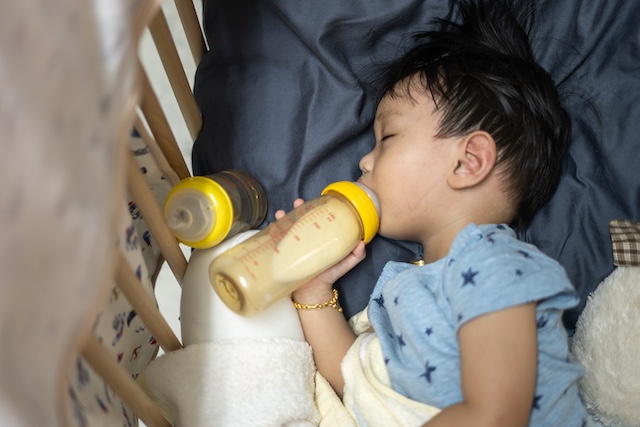
Bottle Feeding Toddlers to Sleep Linked to Tooth Decay and Excess Weight in Early Childhood
Key Takeaways:
- More than three in ten toddlers were still being bottle fed to sleep at two years of age
- Bottle feeding to sleep at age two was linked to almost double the risk of overweight in early childhood
- Continuing the practice at age three was associated with nearly twice as many teeth affected by decay
Parents and carers are being urged to avoid using bottles to help toddlers fall asleep, after new research found clear links between the practice, early childhood tooth decay, and excess weight gain.
The study, published in the Australian and New Zealand Journal of Public Health, was led by researchers at the University of Sydney and drew on data from more than 700 toddlers participating in Western Sydney University’s Healthy Smiles Healthy Kids (HSHK) cohort study. The long running study follows children from birth to examine factors influencing oral health and broader health outcomes.
Study design and data sources
Researchers analysed information collected through surveys completed by mothers, alongside clinical dental examinations and measurements of children’s height and weight. Importantly, the analysis also accounted for a range of other factors known to influence dental health and body weight, allowing the researchers to better isolate the impact of bottle feeding to sleep.
What the researchers found
The findings showed that bottle feeding to sleep remains common well beyond infancy and is associated with measurable health risks:
- More than 30 percent of children were still bottle fed to sleep at two years of age
- Children who were bottle fed to sleep at age two were almost twice as likely to have overweight in early childhood
- Children who were bottle fed to sleep at age three had nearly double the number of teeth affected by dental decay
Why bottle feeding to sleep matters
Lead author Heilok Cheng, a PhD candidate in the Susan Wakil School of Nursing and Midwifery at the University of Sydney, emphasised that most parents and carers are acting with good intentions but may not be fully aware of the longer term risks.
“Australian recommendations advise parents to start introducing cups at 6 months of age and stop using baby bottles at 12 months. Bottle feeding in bed is not recommended at any age. Our research now provides a much more robust evidence base for that advice.”
She explained that many commonly used drinks for toddlers can increase the risk of dental decay.
“Common toddler drinks, including cow’s milk and formula, often contain either natural or added sugars, increasing the risk of tooth decay. When a bottle is offered at bedtime it’s often being used by carers to calm an unsettled child or encourage the child to drift off to sleep. Because the bottle isn’t being offered in response to hunger, it can lead to overfeeding, putting children at risk of unhealthy weight gain.”
Cheng also highlighted the need for better support for families navigating infant and toddler feeding practices.
“We need to do more to support families and help them avoid getting into the habit of putting a child or baby to bed with a bottle, so that our future generations are set up with a healthy future from the start.”
Wider implications for policy and prevention
The authors note that the findings reinforce the importance of coordinated public health action to reduce childhood obesity and improve oral health. They also point to the potential value of universal dental care as part of a broader strategy to prevent avoidable dental disease in early life.
About the Healthy Smiles Healthy Kids study
The Healthy Smiles Healthy Kids (HSHK) cohort study is led by Associate Professor Amit Arora from Western Sydney University, in collaboration with Sydney Local Health District, South Western Sydney Local Health District, the University of Sydney, the University of Queensland, the University of Technology Sydney, and Curtin University.
The study is funded by the Australian National Health and Medical Research Council, NSW Health, the Australian Dental Research Foundation, and the Oral Health Foundation. The full paper, “Bottle feeding to sleep beyond 12 months is associated with higher risk of tooth decay and overweight in Australian children: Findings from the Healthy Smiles Healthy Kids cohort study”, was published in the Australian and New Zealand Journal of Public Health.
CCH insight:
This is an interesting study, which provides very strong evidence for avoiding bedtime bottle-feeding to help infants get to sleep. It would be interesting to know if the excess weight gain resulting from bedtime bottle-feeding is due simply to the extra calories provided by the bedtime milk, or if it also encourages increased emotional eating – it is believed that emotional eating, which is a common cause of overeating in adults, has its behavioural origin in the soothing effect we experience when suckling as a baby, so we come to associate fatty sugary food (like breast or formula milk) with bringing relief from anxiety and stress.