New Self-Aware Biosensor System Could Improve Reliability of Wearable Medical Devices
Key Takeaways:
- Researchers have developed a new biosensor monitoring system that can rapidly detect when electrodes in wearable medical devices begin to detach from the skin.
- The technology evaluates the quality of digital signals transmitted between electrodes through the body, allowing direct monitoring of electrode contact.
- Early testing shows the system can identify early signs of electrode failure that conventional monitoring approaches often miss, potentially improving the reliability of digital health monitoring.
Advances in wearable biosensing for modern healthcare
Smart biomedical technologies are increasingly shaping the future of healthcare. A growing number of digital health tools rely on skin-mounted biosensors that collect detailed physiological data directly from the human body. These devices are commonly used in applications such as heart rhythm monitoring, remote patient monitoring, and long-term health tracking.
As these technologies become more widely adopted in clinical practice and home-based healthcare settings, the accuracy and reliability of the signals they collect become critically important. If the sensors or electrodes attached to the skin begin to loosen or detach, the data captured by the device can become unreliable.
To address this challenge, a research team at King Abdullah University of Science and Technology (KAUST) has developed a new system designed to detect electrode detachment in real time. The technology enables medical devices to identify when electrodes begin to lose proper contact with the skin, allowing clinicians and users to maintain accurate physiological monitoring.
The study describing the system was published in the journal Results in Engineering.
Limitations of traditional electrode monitoring methods
Many wearable medical devices rely on electrodes placed on the skin to detect electrical signals produced by the body, such as those generated by the heart. However, ensuring that these electrodes remain properly attached throughout monitoring can be difficult.
Conventional systems typically rely on indirect methods to determine electrode integrity, such as measuring electrical impedance or using other proxy indicators. These techniques were developed many years ago and often assume stable monitoring conditions.
According to the researchers, these assumptions do not always reflect real-world use.
“Traditional methods for checking whether medical electrodes are properly attached, based on impedance or indirect monitoring, were developed many years ago and assume relatively stable conditions,” explains Rajat Kumar, a student working in the laboratory of Ahmed Eltawil, who led the research.
In everyday situations, however, people move, perspire, and change position. These normal activities can cause electrodes to loosen slightly or temporarily lose contact with the skin.
Such intermittent disruptions can be difficult for conventional monitoring approaches to detect.
“This is especially problematic for home-based wearable medical devices, where poor electrode contact may go unnoticed for long periods, leading to inaccurate data being recorded and relied upon,” says Abdelhay Ali, a postdoctoral researcher in Eltawil’s research group.
Rethinking the body as part of the monitoring system
To overcome these limitations, the KAUST team reconsidered how electrodes interact with the body during monitoring.
Instead of viewing the human body purely as a source of interference in electrical measurements, the researchers explored whether it could become part of the detection mechanism itself.
Eltawil describes this shift in perspective:
“Instead of treating the body as something that interferes with measurements, we considered whether it could be part of the solution.”
Previous research has shown that very small electrical signals can safely travel through the body. The researchers realised that this property could be used to evaluate the condition of electrode attachments.
“We realized that if electrodes could exchange digital signals through the body, then the quality of that communication would directly reflect how well the electrodes were attached,” Kumar says.
If the electrodes remain firmly attached, the signals between them would be transmitted clearly. If the electrodes begin to loosen, the signal quality would deteriorate.
How the self-aware monitoring system operates
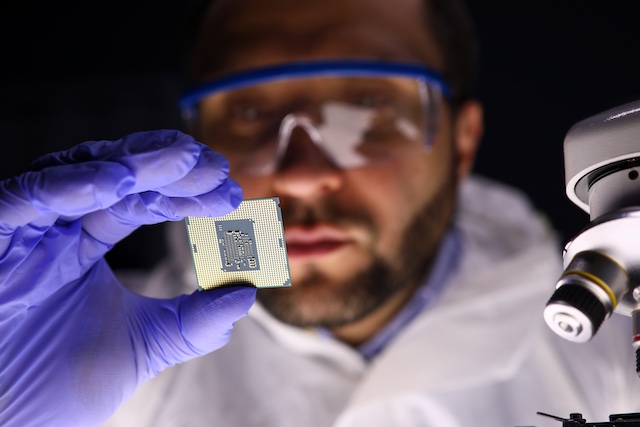
To test this concept, the team developed a monitoring system built around a custom-designed microchip created at KAUST.
The system works by sending very small digital signals between electrodes positioned at different locations on the body. These signals pass through the body and are then received by other electrodes.
A small processing unit analyses how well the signals are received.
According to Ali, the signal quality provides a direct indication of electrode contact:
“Clear signals indicate good electrode skin contact; small errors indicate weakening contact; and missing signals indicate disconnection.”
In addition to the chip and signal-processing unit, the system includes a control component that manages the electrode-checking sequence. This allows the device to automatically evaluate multiple electrodes in sequence without interrupting the primary medical measurements being performed by the device.
Testing the system on human skin
To evaluate the system’s effectiveness, the researchers conducted experiments using electrodes placed on human skin.
The testing showed that the system could reliably distinguish between several different conditions of electrode attachment, including:
- Firmly attached electrodes
- Partially loosened electrodes
- Electrodes that intermittently lose contact with the skin
- Completely disconnected electrodes
Importantly, the system demonstrated the ability to detect early stages of contact degradation before full disconnection occurs.
“Importantly, the system detected the early signs of contact degradation that traditional methods often miss,” Kumar says.
This early detection could be particularly valuable in wearable health monitoring devices that operate continuously over long periods.
Potential benefits for long-term wearable monitoring
A key feature of the new system is its very low power consumption, which makes it suitable for wearable technologies that must operate continuously for hours or days at a time.
Ali explains that this efficiency could make the technology practical for real-world use.
“The system’s very low power consumption should enable practical integration with wearable medical devices that need to run continuously for long periods,” he says.
He also notes that the design could be incorporated into existing devices with minimal modifications.
“These components form a compact and efficient solution that can be added to existing medical devices with minimal changes.”
Towards fully integrated wearable medical devices
Although the current system has been demonstrated in laboratory testing, the research team is now working to advance the technology further.
Their next goal is to develop a fully integrated single-chip system capable of monitoring many electrodes simultaneously.
Such a system could be used in a range of clinical monitoring devices, including multi-lead electrocardiogram (ECG) monitors and other wearable biosensing platforms used in both hospital and home environments.
Eltawil emphasises the broader aim of translating the technology into practical healthcare solutions.
“Ultimately, our goal is to translate this KAUST-developed technology into practical medical devices that are more reliable, more trustworthy, and better suited for continuous health monitoring in the clinic and at home,” he says.