
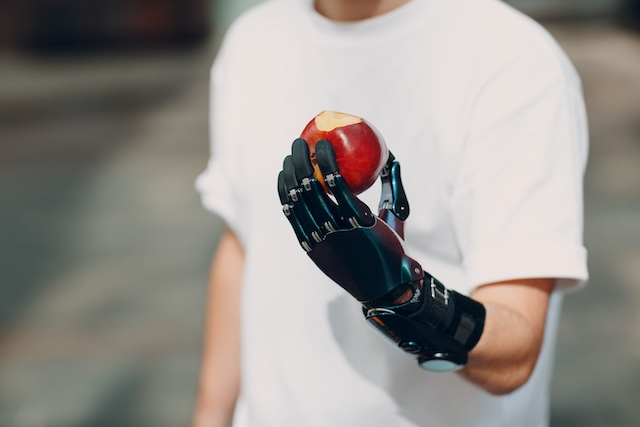
A Smart Exoskeleton Glove Helps People With Hand Paralysis Grasp Everyday Objects
Key Takeaways:
- Researchers in Munich have built a soft, air-powered glove that helps people with hand paralysis grasp everyday objects again.
- Electrical signals from the forearm muscles, read by machine learning, predict a person’s intention to grasp with up to 97% reliability.
- A man living with ALS used the glove to hold a fork for the first time in four years.
A soft exoskeleton driven by air and intention
A soft, pneumatic glove developed at the Technical University of Munich (TUM) is giving people with hand paralysis a way to grasp objects once more. The device was created by researchers at the TUM Chair of Cognitive Systems, who use electrical signals from the forearm muscles to reliably predict the moment a person intends to reach for something. Its designers believe it could one day support people whose hands have been paralysed as a result of accidents or neurological disorders. The research is published in the journal Nature Machine Intelligence.
The team calls the device a “soft-hand exoskeleton”. At its heart is a fabric glove, developed by the researchers, with air cushions fitted to its outer surface. Those cushions are inflated through a total of 13 tubes, each one providing targeted support for the specific hand movements needed to hold a plate or grasp a glass, fork or spoon. Because the cushions can be inflated independently, every finger can be bent and straightened on its own, and the wrist can be rotated too, so that an object can be held securely in the hand.
Reading the intention to grasp
The clever part is knowing when the wearer actually wants to grasp something. To work this out, the researchers measure muscle activity in the forearm. Sensors placed on the forearm capture the faint electrical signals produced by the muscles, and machine learning then analyses those signals to determine the intended movement.
Keeping hold of an object once it has been picked up is a separate challenge. “To prevent objects from being dropped accidentally, we use additional motion sensors to detect transport movements and keep the exoskeleton’s grip securely closed throughout the movement,” says researcher Nicolas Berberich.
Devices like the soft-hand exoskeleton reflect a wider movement of artificial intelligence into everyday clinical care, and professional bodies have increasingly urged healthcare professionals to build the judgement needed to use such tools safely and effectively – the focus of the CPD-accredited digital health training now offered by providers including the College of Contemporary Health.
A soft-hand exoskeleton that anyone can afford
For the team, the appeal of the glove lies as much in its simplicity as in its sophistication. “Our solution is intelligent in two ways,” explains Dr John Nassour. “On the one hand, we’ve developed a highly reliable method of predicting grasping movements by inferring intentions from signals with 97% reliability. On the other hand, with our glove, we’ve developed hardware that optimally supports the intended movements.”
There is a practical advantage on top of that. Dr Nassour sewed the glove himself, and the fabric it requires costs very little. It may not look high-tech at first glance, but it can be used by many people living with paralysis. “We’ve found a solution that anyone can afford but still works very well,” says Prof. Gordon Cheng, director of the Institute for Cognitive Systems.
Central to the project was close collaboration with a man living with amyotrophic lateral sclerosis (ALS).
Working with a person living with ALS
People with ALS gradually lose control of their movements. This happens because the nerve cells responsible for contracting skeletal muscle become damaged and continue to degenerate over time.
By the start of the project, the participant already had very little control over his hands, but he could still move the first joint of his thumb. The researchers built their approach around the strongest signals his thumb muscles could still produce. To record this electromyogram, they attached a sensor to his forearm that picks up the strong signals from the flexor pollicis longus muscle as soon as it moves. Those signals, in turn, trigger the inflation of the glove’s air cushions.
Picking up a fork for the first time in four years
Even though the signals were very weak, the system correctly recognised the participant’s intention in 9 out of 10 cases. With the glove’s support, he was able to reach for objects, hold a fork for the first time in four years, and pick up small cubes and drop them into a container.
A video game played its own part in that progress. The participant had to make a character jump using only the movement of his thumb joint, a simple exercise that helped sharpen the system’s response. The researchers found that just five minutes of this practice was enough to greatly improve his ability to grasp objects. “This patient has shown us that our soft-hand exoskeleton can support him despite one of the most severe neurological disorders,” says Prof. Cheng.
Adapting the glove for more people
The team is now looking beyond ALS. “We are now adapting the concept for other patients, such as stroke survivors,” the researcher adds. A central finding of the current study is that people with severe impairments can more effectively regain the ability to grasp objects with the help of the glove.
That potential is echoed by clinicians working alongside the researchers. Neurologist Prof. Tobias Wächter, from the partner institution Klinik Passauer Wolf, is convinced of what the specialised glove could offer. “In principle, this glove can help people with flaccid paralysis, including, for example, people who have sustained peripheral nerve damage following motorcycle or bicycle accidents, or patients with polyneuropathy,” says Prof. Wächter.
CCH insight
As AI-assisted and digital health tools move from the research lab into everyday practice, the ability to evaluate them safely and confidently is fast becoming a core clinical skill. The College of Contemporary Health’s CPD-accredited short course AI Essentials for Primary Care (3.5 CPD hours) helps nurses, pharmacists, physician associates and the wider team assess new tools, work within clinical governance, and use them responsibly in patient care – no technical background required.
Explore AI Essentials for Primary Care →
Read More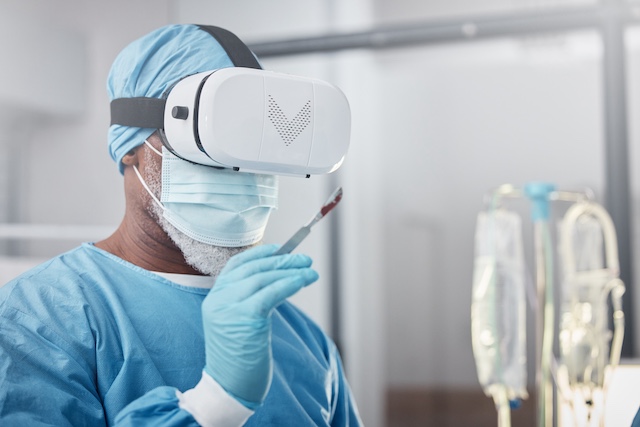
First UK Long-Distance Robotic Surgery Connects London Surgeon with Gibraltar Patient
Key Takeaways:
- A London-based surgeon has performed the UK’s first long-distance robotic cancer surgery on a patient in Gibraltar, marking a major milestone in telesurgery
- The procedure demonstrated minimal delay and high precision, suggesting remote surgery could expand access to specialist care in underserved regions
- Patients living far from specialist centres may benefit from reduced travel, lower costs and improved continuity of care
A landmark moment in remote surgery
A surgeon based in London has carried out what is believed to be the United Kingdom’s first long-distance robotic surgical procedure, operating on a patient located approximately 1,500 miles (2,400 km) away in Gibraltar.
Professor Prokar Dasgupta, a leading robotic urological surgeon, performed a prostate removal on 62-year-old Paul Buxton. Reflecting on the experience, he said it felt “almost as if I was there”, despite the geographical distance between surgeon and patient.
For Buxton, who is living with prostate cancer, the decision to participate in the procedure was straightforward. He described it as a “no-brainer” and an opportunity to become “part of medical history”.
Expanding access to specialist care
The development of long-distance robotic surgery is seen as a potential solution to longstanding challenges in healthcare access, particularly for people living in remote or underserved regions.
Such approaches could reduce the “vast expense and inconvenience” associated with travelling for specialist treatment, while enabling patients to receive care closer to home.
This milestone builds on previous advances involving UK-based surgical teams. Earlier work included a transatlantic robotic stroke procedure conducted over a distance of 4,000 miles on a cadaver – a body donated to science – which demonstrated that long-distance surgery was technically feasible.
A patient’s perspective
Buxton, originally from Burnham-on-Sea in Somerset, has lived in Gibraltar for four decades. As a British Overseas Territory, Gibraltar has limited healthcare infrastructure, with only one hospital – St Bernard’s Hospital at Europort. Patients requiring more complex care often need to travel abroad, commonly to the United Kingdom for NHS treatment if eligible.
Following his prostate cancer diagnosis shortly after Christmas, Buxton initially expected to join an NHS waiting list. However, he chose instead to take part in the remote surgery trial.
“A lot of people actually said to me: ‘You’re not going to do it, are you?’”
“I thought, I’m giving something back here,” he said.
Buxton also highlighted the practical advantages of the approach:
“If I hadn’t gone for the telesurgery in Gibraltar, then I would have had to have flown to London, I would have had to go on the NHS waiting list, get the procedure done and I would have probably been in London for three weeks.
“So I thought: ‘This is a no-brainer’.
“It is pioneering for Gibraltar, because you don’t need to leave Gibraltar.”
Following the operation on 11 February, he reported a positive recovery, stating he was “really well looked after” and “feeling fantastic”.
How the technology works
The procedure was conducted from The London Clinic using a robotic surgical system equipped with a high-definition 3D camera and four robotic arms. These were controlled remotely via a surgical console.
The connection between London and Gibraltar was enabled through fibre-optic cables, supported by a backup 5G link. The system achieved an extremely low latency, with a delay of just 0.06 seconds, allowing for precise and responsive control.
A surgical team in Gibraltar remained on standby throughout the operation to intervene if necessary, although the connection remained stable for the duration of the procedure.
The operation utilised the Toumai Robotic System and was delivered through a collaboration between The London Clinic and the Gibraltar Health Authority.
Looking ahead: scaling telesurgery
Professor Dasgupta emphasised the broader implications of the innovation:
“This gives us the opportunity to treat patients in remote areas and smaller communities by literally being able to take the best surgeon anywhere.”
The procedure forms part of an initial series of test cases. A second operation involving a 52-year-old patient in Gibraltar was carried out on 4 March, with a further procedure scheduled for 14 March.
The upcoming operation will be live-streamed to 20,000 leading urological surgeons attending the European Association of Urology congress, highlighting the global interest in this emerging field.
Reflecting on the future, Dasgupta added:
“I think it is very, very exciting, the humanitarian benefit is going to be significant.”
Alignment with broader surgical trends
This development sits alongside wider efforts to expand the use of robotic-assisted surgery within the NHS. Current ambitions include scaling up to 500,000 robot-supported operations annually by 2035.
While the NHS is prioritising local access to robotic surgery, advances in telesurgery suggest a complementary pathway – one that could extend specialist expertise beyond physical borders and reshape how surgical care is delivered globally.
CCH insight
Telesurgery is one of the most striking examples yet of a much broader shift: the rapid digital transformation of healthcare. From remote care to AI and connected devices, digital health is fast becoming core to practice rather than a niche – and being equipped for this new frontier is increasingly imperative for healthcare professionals. CCH’s CPD-accredited digital health short courses are designed to help practitioners build the practical skills and judgement to keep pace, quickly and flexibly around a clinical schedule.
Explore CCH’s Digital Health courses →
AI-Enabled Social Robots Show Early Promise for Patient and Clinician Acceptance
Key Takeaways:
- A pilot study suggests that a GPT-controlled social robot is acceptable to both patients and healthcare professionals in a hospital setting.
- The research focused on technical, organisational and ethical feasibility, rather than on demonstrating improvements in care quality.
- Careful system design, including restricting information sources to clinician-validated content, was central to building trust and reducing risk.
Early insights into acceptance and feasibility
Researchers from University of Twente, Medisch Spectrum Twente and Politecnico di Milano have conducted a pilot study examining whether a GPT-controlled social robot could support people receiving care with medical information in a hospital environment. The initial findings suggest cautious optimism. Both patients and caregivers found the technology acceptable in practice.
The study examined not whether such a system improves clinical outcomes, but whether it can function safely and appropriately within real healthcare settings. Technical robustness, organisational fit and ethical considerations were all central to the research design.
Healthcare systems are facing sustained pressure from workforce shortages and rising demand. At the same time, clear, accessible communication remains essential, particularly for people living with chronic conditions. Digital tools may help address these challenges, but they also raise important questions around reliability, trust and governance.
The findings have been published in the journal Frontiers in Digital Health.
Exploring artificial intelligence with a physical presence
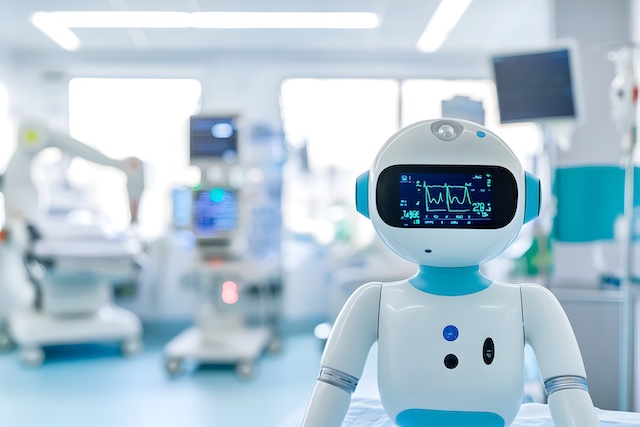
Within this context, the research team investigated whether a social robot, powered by GPT technology, could provide people receiving care with information about their condition and treatment. The system combined a physical robot with a human-like face, facial expressions and speech capabilities, enabling natural spoken interaction.
According to the study, this physical presence was well received by both patients and healthcare professionals. People described the conversations as accessible and pleasant. However, the researchers were careful to frame these findings appropriately.
“This should not be interpreted as evidence that care quality improves,” emphasised lead researcher Jan-Willem van ‘t Klooster. “We investigated whether such a system can function in practice, not whether it already improves care.”
Tested in real clinical settings
The research began with a controlled laboratory study before moving into everyday clinical practice. In total, 21 people with osteoarthritis and seven healthcare professionals interacted with the robot in the hospital setting. Both groups rated the system positively in terms of usability and overall acceptance.
Van ’t Klooster highlighted the importance of this early step. “Acceptance is a first step. Then you can investigate whether such a technology really contributes to better information provision, therapy adherence or time savings for health care providers.”
Managing risk through controlled use of AI
A key aspect of the project was how artificial intelligence was implemented. The GPT system did not have unrestricted access to the internet. Instead, it was limited to information drawn from pre-approved, clinician-validated medical websites. This approach was designed to reduce the risk of incorrect or fabricated responses, often referred to as hallucinations.
“The debate is often about whether you should use AI in health care,” said Van ’t Klooster. “We show that it is mainly about how you set it up. By setting clear boundaries, control remains in the hands of health care professionals.”
Collaboration across disciplines
The project brought together expertise from behavioural science, clinical practice, design and technology. Alongside researchers from the University of Twente, healthcare professionals, designers and international partners contributed to the study.
“It is precisely this collaboration that makes this kind of research possible,” Van ’t Klooster noted.
The authors stress that further work is needed before such systems could be considered for broader implementation. Planned follow-up research includes examining long-term use, knowledge transfer and the appropriate language level for patient communication, ensuring that future applications remain accessible, safe and trustworthy for people receiving care.
Read More