AI-Enabled Social Robots Show Early Promise for Patient and Clinician Acceptance
Key Takeaways:
- A pilot study suggests that a GPT-controlled social robot is acceptable to both patients and healthcare professionals in a hospital setting.
- The research focused on technical, organisational and ethical feasibility, rather than on demonstrating improvements in care quality.
- Careful system design, including restricting information sources to clinician-validated content, was central to building trust and reducing risk.
Early insights into acceptance and feasibility
Researchers from University of Twente, Medisch Spectrum Twente and Politecnico di Milano have conducted a pilot study examining whether a GPT-controlled social robot could support people receiving care with medical information in a hospital environment. The initial findings suggest cautious optimism. Both patients and caregivers found the technology acceptable in practice.
The study examined not whether such a system improves clinical outcomes, but whether it can function safely and appropriately within real healthcare settings. Technical robustness, organisational fit and ethical considerations were all central to the research design.
Healthcare systems are facing sustained pressure from workforce shortages and rising demand. At the same time, clear, accessible communication remains essential, particularly for people living with chronic conditions. Digital tools may help address these challenges, but they also raise important questions around reliability, trust and governance.
The findings have been published in the journal Frontiers in Digital Health.
Exploring artificial intelligence with a physical presence
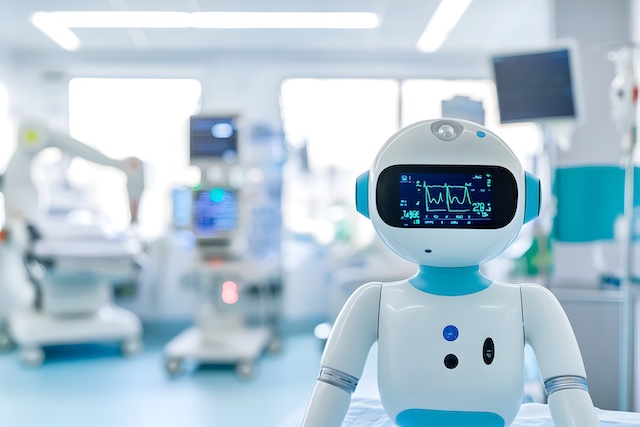
Within this context, the research team investigated whether a social robot, powered by GPT technology, could provide people receiving care with information about their condition and treatment. The system combined a physical robot with a human-like face, facial expressions and speech capabilities, enabling natural spoken interaction.
According to the study, this physical presence was well received by both patients and healthcare professionals. People described the conversations as accessible and pleasant. However, the researchers were careful to frame these findings appropriately.
“This should not be interpreted as evidence that care quality improves,” emphasised lead researcher Jan-Willem van ‘t Klooster. “We investigated whether such a system can function in practice, not whether it already improves care.”
Tested in real clinical settings
The research began with a controlled laboratory study before moving into everyday clinical practice. In total, 21 people with osteoarthritis and seven healthcare professionals interacted with the robot in the hospital setting. Both groups rated the system positively in terms of usability and overall acceptance.
Van ’t Klooster highlighted the importance of this early step. “Acceptance is a first step. Then you can investigate whether such a technology really contributes to better information provision, therapy adherence or time savings for health care providers.”
Managing risk through controlled use of AI
A key aspect of the project was how artificial intelligence was implemented. The GPT system did not have unrestricted access to the internet. Instead, it was limited to information drawn from pre-approved, clinician-validated medical websites. This approach was designed to reduce the risk of incorrect or fabricated responses, often referred to as hallucinations.
“The debate is often about whether you should use AI in health care,” said Van ’t Klooster. “We show that it is mainly about how you set it up. By setting clear boundaries, control remains in the hands of health care professionals.”
Collaboration across disciplines
The project brought together expertise from behavioural science, clinical practice, design and technology. Alongside researchers from the University of Twente, healthcare professionals, designers and international partners contributed to the study.
“It is precisely this collaboration that makes this kind of research possible,” Van ’t Klooster noted.
The authors stress that further work is needed before such systems could be considered for broader implementation. Planned follow-up research includes examining long-term use, knowledge transfer and the appropriate language level for patient communication, ensuring that future applications remain accessible, safe and trustworthy for people receiving care.